
WELCOME :: SUITES :: RESERVATIONS :: ACTIVITIES :: DIRECTIONS :: REVIEWS & COMMENTS
MONEY $AVING AFFILIATES :: CULTURE & HISTORY :: LINKS :: LEGAL INFO

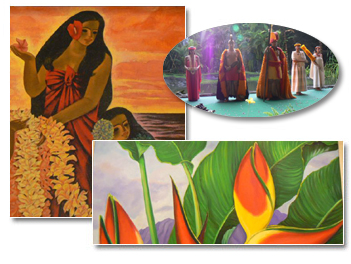
Ancient Polynesian explorers most likely reached South America as well, evidenced by the fact that the sweet potato is grown throughout ancient Polynesia but originated in the Andes! However there is no evidence that the Polynesians settled in South America or that the South Americans traveled to Polynesia in pre-history. The great Polynesian migrations were made by whole villages and in their great double-hulled canoes. They brought their crops, pets and some stowaways that settled the islands along with them like geckos. The ancient Polynesians motivation seems to have been population pressures and their legends speak of their great explorers as discoverers, not conquerors. By 850 AD the seven main Hawaiian islands were settled. A second wave of migrations may have arrived around 1100 AD from Tahiti. The isolated Hawaiians had lessand less contact with the rest of the Polynesian world and developed their own distinct culture. Hawaiian culture was certainly well established by 1400 AD, the exciting history and culture of ancient Hawaii was in full swing! |


On Kauai, the Garden Island, is the centrally located, southwest, "upcountry town of Kalaheo". Just minutes to Poipu Beach, Hanapepe, Koloa, Port Allen, Waimea and four of Kauai's famous State Parks of Polihale,Waimea Canyon, Koke'e and the Napali Coast. HAWAIIAN NATURAL HISTORY |
ORIGINS OF THE ANCIENT HAWAIIANS AND THEIR CULTRUE The isolation of the Hawaiian Islands in the middle of the Pacific Ocean, and the wide range of environments to be found on high islands located in and near the tropics, has resulted in a vast array of endemic flora and fauna. Hawaii has more endangered species per square mile than anywhere else. Ancient tribal Polynesians arrived on this virgin scene after long, amazing sea voyages in their double-hulled canoes. The early Polynesians were an adventurous seafaring people with highly developed navigational skills. They used the sun, stars and wave patterns to find their directions. Ancient Polynesians even created incredible maps of wave patterns by binding sticks together. Bird flight paths and cloud patterns were used to discern where islands were located. Entire villages set forth upon ocean going double-hulled canoes to discover unsettled lands. Maternal mitrochondrial DNA evidence indicates that the ancient Polynesians, including the Hawaiians, are genetically linked to indigenous people of Southeast Asia. This is supported by both by archeological and linguistic evidence. Speakers of Austronesian languages spread into the western islands of Micronesia and then Melanesia between 3000 and 1500 BC. The historic path of the ancient Polynesians can be followed with a large degree of certainty through the arch-eological record they left behind. A distinct culture appeared c. 1500 BC in Northwest Melanesia, Known as the Lapita, this culture stands out in the archeological record with its large permanent villages with beach terraces located along the coasts. They also developed pottery in a wide variety of shapes and patterns. From its origins in Melanesia the Lapita culture spread some 3,700 miles to the East to Samoa and Tonga. Here the distinct Polynesian culture developed and spread outward into the rest of the Polynesian triangle. Arch--eological evidence indicates that the Polynesians had reached the eastern corner at Easter Island, Western corner at New Zealand and the Northern corner Hawaii by 700 A.D., by contrast the Viking culture had not settled in Iceland until 875 AD. |
"Click Below For Great Discounts"

|
 |
 |
 |
 |
 |
  |
The Friendly Inn with the Friendly Price! ©Copyright 2010 All Right Reserved, KalaheoInn.Com |
 |
| Site Design by BLCJPL Ohana LLC | Site maintained by Branden Sun, BLCJPL |